
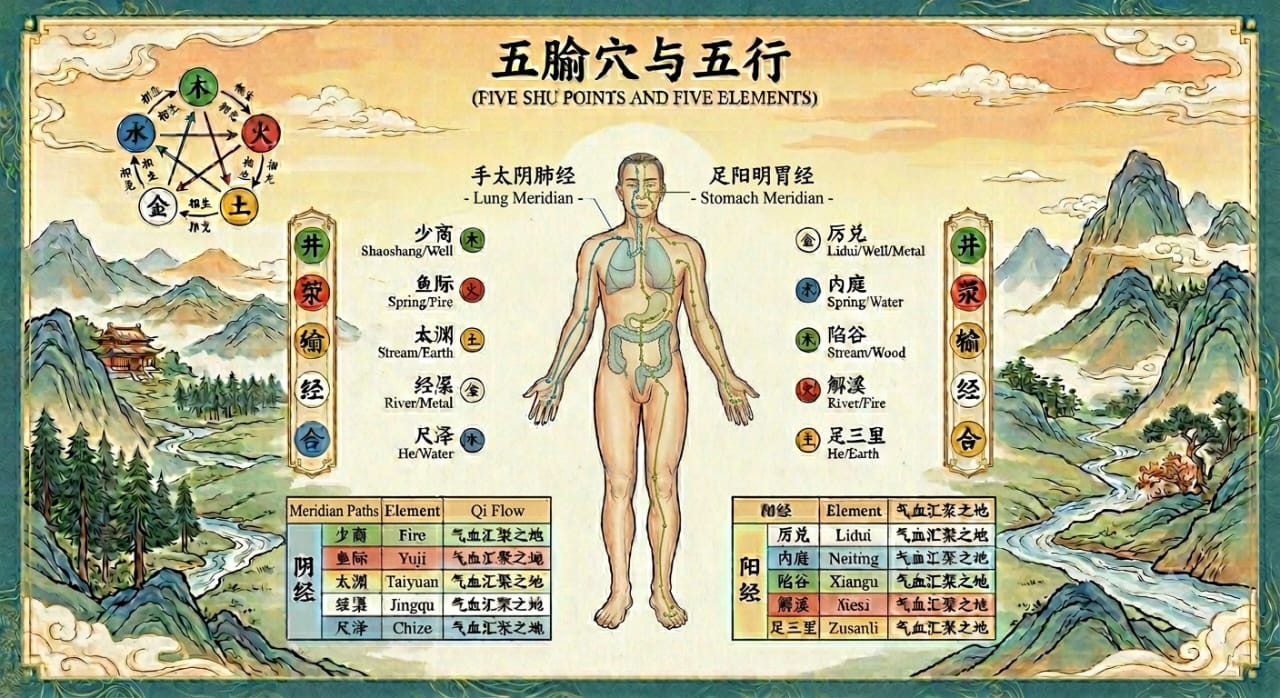
Understanding the Five-Shu Points and Their Relationship with the Five Elements
Understanding the Five-Shu Points and Their Relationship with the Five Elements
A Fundamental Concept in Traditional Chinese Medicine
The Five-Shu Points (Jing-Well, Ying-Spring, Shu-Stream, Jing-River, and He-Sea) are among the most important acupuncture points in Traditional Chinese Medicine (TCM). These points are located below the elbows and knees along each of the Twelve Primary Meridians and play a significant role in acupuncture diagnosis and treatment.
Ancient physicians observed the natural world and used the flow of water to describe the movement of Qi within the meridians. Just as water begins as a small spring, grows into a stream, flows into a river, and eventually reaches the sea, the Qi within the meridians is believed to flow from superficial to deep and from weak to abundant.
This concept forms the foundation of the Five-Shu Point theory.
The Five-Shu Points Explained
| Category | Water Analogy | Characteristics |
| Jing-Well | Spring | Qi emerges |
| Ying-Spring | Stream | Qi begins to flow |
| Shu-Stream | Brook | Qi gradually increases |
| Jing-River | River | Qi becomes abundant |
| He-Sea | Sea | Qi gathers deeply |
These five categories illustrate the progressive movement of meridian Qi throughout the body.
The Five-Shu Points and the Five Elements
One of the unique features of the Five-Shu Points is their relationship with the Five Elements: Wood, Fire, Earth, Metal, and Water.
For Yin Meridians:
- Jing-Well → Wood
- Ying-Spring → Fire
- Shu-Stream → Earth
- Jing-River → Metal
- He-Sea → Water
For Yang Meridians:
- Jing-Well → Metal
- Ying-Spring → Water
- Shu-Stream → Wood
- Jing-River → Fire
- He-Sea → Earth
This arrangement allows practitioners to apply Five Element theory directly in acupuncture point selection.
The Generation Cycle (Sheng Cycle)
The Five Elements support and nourish one another through the Generation Cycle:
Wood → Fire → Earth → Metal → Water → Wood
Examples:
- Wood generates Fire
- Fire generates Earth
- Earth generates Metal
- Metal generates Water
- Water generates Wood
Clinical Application
A classical principle states:
“Tonify the Mother in Deficiency.”
For example, the Lung belongs to the Metal element. Since Earth generates Metal, an Earth point on the Lung Meridian may be selected to strengthen Lung Qi when deficiency is present.
The Control Cycle (Ke Cycle)
To maintain balance, the Five Elements also regulate one another through the Control Cycle:
Wood → Earth → Water → Fire → Metal → Wood
Examples:
- Wood controls Earth
- Earth controls Water
- Water controls Fire
- Fire controls Metal
- Metal controls Wood
Clinical Application
When an organ or meridian displays an excess pattern, practitioners may apply the principle of reducing the Child element or utilise the controlling relationship to restore balance.
For example, Metal controls Wood. Therefore, Metal-related points may be considered when addressing certain excess patterns associated with the Liver meridian.
Why Are the Five-Shu Points Important?
The Five-Shu Points represent the integration of:
- Meridian Theory
- Five Element Theory
- Organ System Relationships
- Acupuncture Point Selection
By understanding these relationships, practitioners can select points more systematically and tailor treatments according to individual patterns of disharmony.
Conclusion
The Five-Shu Points are much more than five acupuncture points on each meridian. They represent a sophisticated framework that connects the flow of Qi with the principles of the Five Elements.
Understanding the Generation and Control Cycles enables practitioners to apply classical treatment principles and appreciate the depth of Traditional Chinese Medicine theory.
………………………………………………………………………………………………………………………………………………………………………………………………………..
Disclaimer: This article is for general informational purposes only and does not constitute medical advice, diagnosis, or treatment. Please consult a qualified healthcare professional before making any healthcare decisions.