
Understanding the Body’s Mingmen Fire Through a Traditional Rotating Lantern
Understanding the Body’s Mingmen Fire Through a Traditional Rotating Lantern
In the previous article, we used the traditional Chinese rotating lantern (zouma deng) as an analogy to explain the relationships between Kidney Essence (Jing), Kidney Qi, Kidney Yang, and Kidney Yin. This vivid analogy originated from Yiguan (The Complete Medical Guide) by the renowned Ming Dynasty physician Zhao Xianke.
Zhao Xianke wrote:
“Let me give an analogy. Imagine the revolving lantern displayed during the Lantern Festival. Within it are figures bowing, dancing, flying, and running. All are present. Yet at its center there is only a single flame. When the flame burns strongly, the figures move quickly. When the flame weakens, they move slowly. When the flame is extinguished, everything becomes still. Yet the figures themselves remain intact.”
Although brief, these words reveal a profound insight into the nature of life.
The Philosophy of Life Within a Lantern
In a traditional Lantern Festival revolving lantern, we see beautifully crafted figures dancing, running, flying, and performing various activities. They appear lively, almost as if they possess life of their own.
However, the true source of all this movement is not the figures themselves, but the flame burning at the center of the lantern.
When the flame is strong, the lantern spins rapidly and the figures appear energetic and lively.
When the flame weakens, the lantern slows down and the figures move sluggishly.
When the flame goes out, the lantern immediately stops, and every figure becomes motionless.
More interestingly, even after the flame has been extinguished, the figures themselves remain intact. They simply lose the ability to move.
Through this analogy, Zhao Xianke illustrated that behind all life activities lies a fundamental force that drives everything.
The Human Body Is Like a Rotating Lantern
From the perspective of Traditional Chinese Medicine (TCM), the human body resembles this revolving lantern.
The beating of the heart, breathing of the lungs, digestion of the spleen and stomach, the liver’s regulatory functions, thinking of the brain, and movement of muscles all appear to operate independently, much like the different figures inside the lantern.
Yet these functions do not truly operate on their own.
Behind them exists a common source of power.
Zhao Xianke referred to this life-giving force as the Mingmen Fire.
This “fire” is not a literal flame inside the body. Rather, it symbolizes the fundamental energy and vitality that sustains life.
Just as modern society depends on electricity, the body’s physiological activities depend upon the power of the Mingmen Fire.
Are Mingmen Fire, Kidney Yang, and Kidney Qi the Same?
At this point, many readers may wonder:
If Mingmen Fire is so important, is it the same as Kidney Yang or Kidney Qi?
The answer is no.
The three are closely related, but they are not identical.
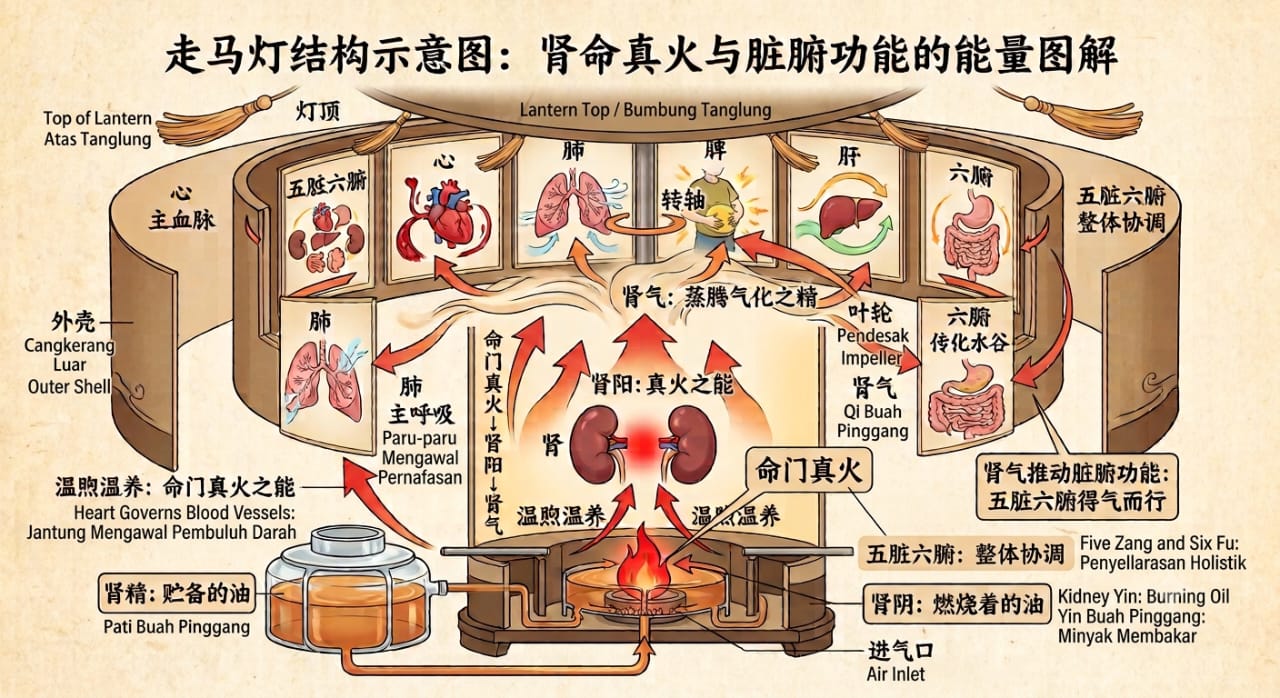
Using the revolving lantern analogy:
- The flame at the center represents Mingmen Fire.
- The warmth generated by the flame represents Kidney Yang.
- The driving force that turns the lantern wheel represents Kidney Qi.
In other words:
- Mingmen Fire is the source.
- Kidney Yang is the warming and activating energy produced by it.
- Kidney Qi is the functional manifestation of that energy.
Therefore, Mingmen Fire is neither exactly Kidney Yang nor Kidney Qi.
If we must compare them, Mingmen Fire is best understood as the root of Kidney Yang.
Understanding Through the Sun and Sunlight
Another useful analogy is the relationship between the sun and sunlight.
Are the sun and sunlight the same thing?
Clearly not.
The sun is the source, while sunlight is the energy and influence emitted by the sun.
Likewise:
- Mingmen Fire is like the sun.
- Kidney Yang is like sunlight.
- Kidney Qi is the life functions made possible by that sunlight.
Without the sun, there would be no sunlight.
Without sunlight, life could not flourish.
Thus, Mingmen Fire, Kidney Yang, and Kidney Qi are distinct concepts, yet they are inseparably connected.
How Does Kidney Qi Manifest?
When Mingmen Fire functions properly, the body expresses a variety of normal physiological activities.
These are the manifestations of Kidney Qi, including:
- Growth and development
- Reproductive function
- Retention and regulation functions
- Receiving Qi during respiration
- Water metabolism
- Bone development and strength
- Mental vitality and energy
Kidney Qi therefore refers more to the body’s functional performance than to a specific form of energy.
Why Did Zhao Xianke Place So Much Importance on Mingmen?
In Zhao Xianke’s view, although the five zang organs and six fu organs each have their own responsibilities, none of them are the ultimate source of life.
Just as the figures inside the lantern are not the source of movement, the organs themselves are not the ultimate source of vitality.
The true driving force behind all physiological activities is the Mingmen Fire.
When Mingmen Fire is abundant, the body enjoys vitality, smooth circulation, and harmonious organ function.
When it weakens, fatigue, cold intolerance, impaired metabolism, and declining vitality may appear.
When it is extinguished, life itself comes to an end.
Conclusion
A simple revolving lantern contains profound wisdom about the nature of life.
The figures may be numerous and diverse, but they are not the source of movement. Likewise, the body’s many organs and functions are not the ultimate source of life.
Behind everything lies an invisible yet essential force.
In its simplest form:
Mingmen Fire (Source Flame) → Kidney Yang (Thermal Energy) → Kidney Qi (Functional Expression)
Understanding the relationship between these three concepts helps us gain a deeper appreciation of Traditional Chinese Medicine and offers a unique perspective on health, vitality, and longevity.
In many ways, protecting the Mingmen Fire is protecting life itself.
………………………………………………………………………………………………………………………………………………………………………………………………………..
Disclaimer: This article is for general informational purposes only and does not constitute medical advice, diagnosis, or treatment. Please consult a qualified healthcare professional before making any healthcare decisions.