
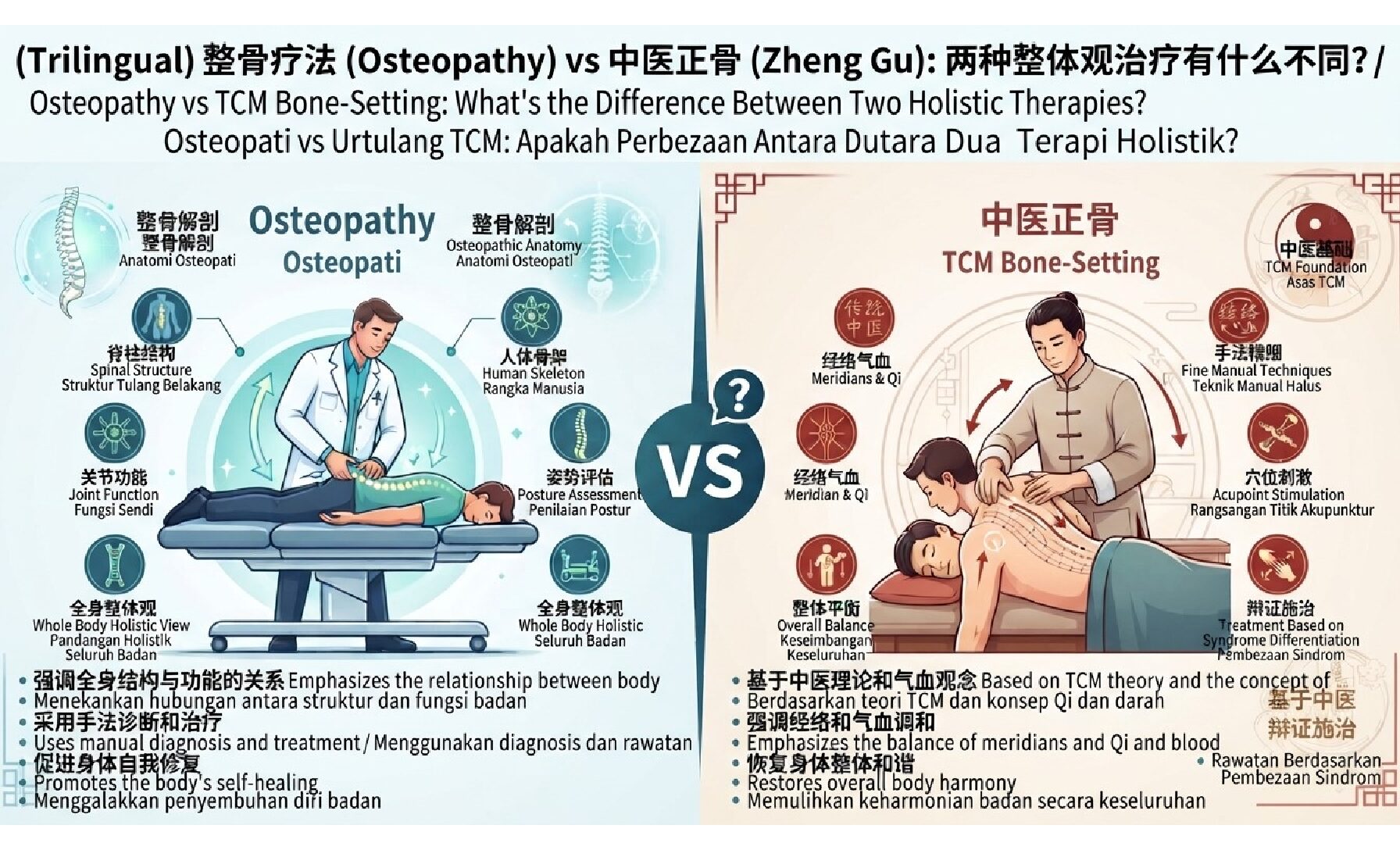
Osteopathy vs Traditional Chinese Bone Setting: What Are the Differences Between Two Holistic Approaches?
Understanding Two Manual Therapy Approaches That Emphasize the Whole Body
When it comes to musculoskeletal health, posture-related concerns, chronic discomfort, or movement restrictions, many people may come across Osteopathy or Traditional Chinese Bone Setting.
Interestingly, although Osteopathy originated from a Western healthcare tradition and Traditional Chinese Bone Setting originated from Traditional Chinese Medicine (TCM), both approaches emphasize that the human body functions as an interconnected whole rather than focusing solely on the location of symptoms.
As a result, many people wonder:
What is the difference between Osteopathy and Traditional Chinese Bone Setting?
This article explores their origins, theoretical foundations, treatment approaches, and development in Malaysia.
What Is Osteopathy?
Osteopathy was founded by American physician Andrew Taylor Still (A.T. Still) in 1874, making it older than Chiropractic.
Its core philosophy proposes that body structure and function are closely related, and that the body has the capacity for self-regulation and self-maintenance of health. Therefore, assessment and treatment should consider the whole person rather than focusing only on localized symptoms.
The word “Osteopathy” comes from the Greek words:
- Osteon (bone)
- Pathos (condition or suffering)
Modern Osteopathy emphasizes:
- A holistic approach
- The relationship between structure and function
- Assessment of movement and physical function
- Manual therapy
- Musculoskeletal health management
Under Malaysia’s Traditional and Complementary Medicine (T&CM) framework, Osteopathy is one of the recognized practice areas under the Traditional and Complementary Medicine Act 2016 (Act 775).
What Is Traditional Chinese Bone Setting?
Traditional Chinese Bone Setting is an important branch of Traditional Chinese Medicine traumatology and musculoskeletal care, with a history dating back to ancient China.
Over centuries, Chinese physicians developed techniques aimed at restoring function and balance while managing injuries, dislocations, fractures, and soft tissue conditions.
Traditional Chinese Bone Setting is based on TCM principles and emphasizes:
- The importance of both bones and soft tissues
- Harmony between bones, tendons, and muscles
- The circulation of Qi and Blood through the meridians
- Integration of local and whole-body considerations
- Balance of Yin and Yang
In modern clinical practice, Traditional Chinese Bone Setting is often combined with:
- Tui Na (Chinese therapeutic massage)
- Acupuncture
- Cupping therapy
- External herbal applications
to support overall health management.
In Malaysia, Traditional Chinese Bone Setting generally falls within the scope of Traditional Chinese Medicine practice and is regulated under the Traditional and Complementary Medicine Act 2016 (Act 775).
The Greatest Similarity: Both Emphasize a Holistic Perspective
Although they originate from different cultures and medical systems, both approaches share an important principle.
Looking Beyond the Area of Pain
For example, a patient may seek care for lower back discomfort.
Whether consulting an Osteopath or a Traditional Chinese Bone Setting practitioner, the assessment may include:
- Pelvic alignment
- Walking pattern
- Body balance
- Postural habits
- Muscle tension distribution
- Other related functional concerns
This is because both approaches recognize that:
The location of symptoms may not always represent the source of the problem.
Both Value the Relationship Between Structure and Function
Osteopathy proposes that changes in body structure may influence function.
Traditional Chinese Bone Setting proposes that imbalances involving bones, tendons, and muscles may affect the circulation of Qi and Blood and the body’s overall coordination.
Although the explanations differ, both approaches focus on:
- Body balance
- Physical function
- Structural coordination
- Overall health status
How Are Osteopathy and Traditional Chinese Bone Setting Different?
1. Different Theoretical Foundations
Osteopathy
Osteopathy is primarily based on:
- Anatomy
- Physiology
- Biomechanics
- Musculoskeletal science
Its analysis generally follows a modern healthcare framework.
Traditional Chinese Bone Setting
Traditional Chinese Bone Setting is primarily based on:
- Fundamental TCM theories
- Meridian theory
- Qi and Blood theory
- Yin-Yang theory
- Zang-Fu theory
Assessment is often integrated with TCM pattern differentiation principles.
2. Different Perspectives in Assessing the Body
Osteopathy commonly evaluates:
- Joint mobility
- Soft tissue tension
- Biomechanics
- Functional restrictions
Traditional Chinese Bone Setting may additionally consider:
- Meridian pathways
- Qi and Blood circulation
- Relationships between bones, tendons, and muscles
- Individual constitutional characteristics
3. Different Treatment Approaches
Common Osteopathic Techniques
- Joint mobilization
- Soft tissue techniques
- Myofascial release
- Functional techniques
- Whole-body assessment
Common Traditional Chinese Bone Setting Techniques
- Bone-setting manipulation
- Tendon and soft tissue regulation
- Tui Na
- Meridian-based techniques
- Integration with acupuncture or external herbal therapies
Specific treatment methods vary according to the practitioner’s training and the individual’s condition.
Development in Malaysia
Under Malaysia’s Traditional and Complementary Medicine (T&CM) framework, both Osteopathy and Traditional Chinese Medicine are recognized practice areas under the Traditional and Complementary Medicine Act 2016 (Act 775).
Practitioners are expected to meet relevant qualification requirements and comply with applicable regulations.
When seeking these services, members of the public are encouraged to review practitioners’ qualifications, registration status, and professional background.
Which One May Be Suitable for You?
There is no single approach that is universally best for everyone.
Each profession has its own history, philosophy, and way of assessing the body.
Some individuals may prefer:
- Osteopathy’s focus on structure and functional assessment
Others may prefer:
- Traditional Chinese Bone Setting’s integration of meridian theory and musculoskeletal regulation
The most important considerations are:
- Receiving an appropriate assessment
- Understanding your individual needs
- Choosing a qualified practitioner
- Discussing suitable treatment options with healthcare professionals
Conclusion
Although Osteopathy and Traditional Chinese Bone Setting originate from different healthcare traditions, both emphasize the body as an interconnected whole.
Osteopathy focuses on the relationship between structure and function, while Traditional Chinese Bone Setting places greater emphasis on the coordination of bones, tendons, muscles, meridians, and the circulation of Qi and Blood.
Understanding both their similarities and differences can help individuals make more informed decisions when exploring healthcare options.
…………………………………………………………………………………………………………………………………………………………………………
Disclaimer: This article is for general informational purposes only and does not constitute medical advice, diagnosis, or treatment. Please consult a qualified healthcare professional before making any healthcare decisions.