
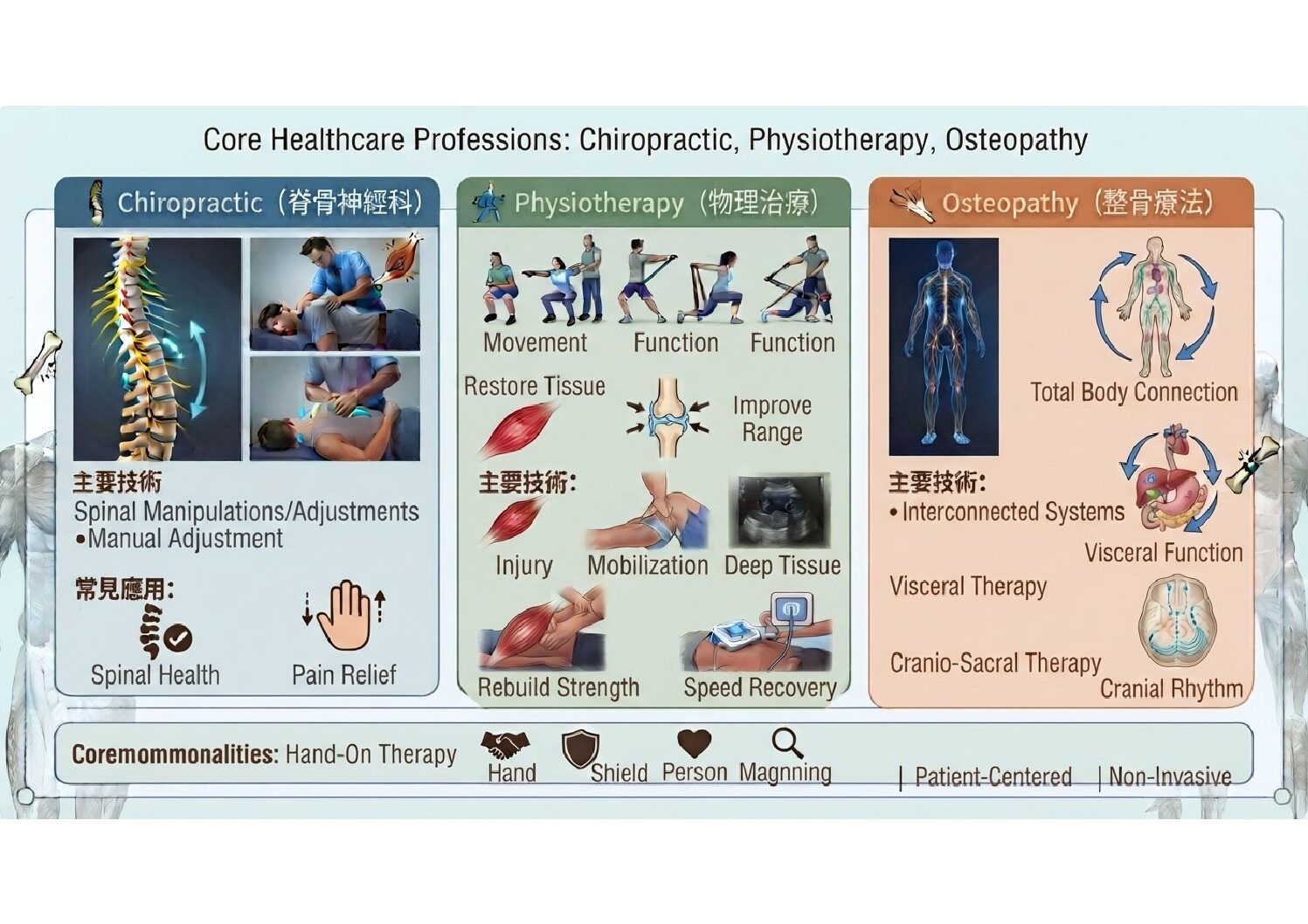
Chiropractic, Physiotherapy and Osteopathy: What Are the Differences Between These Three Western Healthcare Professions?
Understanding Three Common Approaches to Musculoskeletal Care
When dealing with neck and shoulder pain, back discomfort, sports injuries, or limitations in movement, many people may come across the following healthcare professions:
- Chiropractic
- Physiotherapy
- Osteopathy
Because all three are involved in improving muscles, joints, bones, and body function, they are often confused with one another.
In reality, although they all originated from Western healthcare systems, they have different histories, philosophies, and clinical focuses.
What Do They Have in Common?
Whether it is Chiropractic, Physiotherapy, or Osteopathy, they share several common goals:
- Improving mobility and movement
- Reducing musculoskeletal discomfort
- Supporting functional recovery
- Enhancing quality of life
- Minimizing the impact of pain on daily activities
As a result, there may be some overlap between these professions, and in certain situations, they may complement one another.
The Origin of Osteopathy
Osteopathy was founded by American physician Andrew Taylor Still (A.T. Still) in 1874, making it older than Chiropractic. In 1892, he established the first school of Osteopathy.
The term “Osteopathy” is derived from Greek words:
- Osteon (bone)
- Pathos (condition or suffering)
A.T. Still believed that structure and function are closely interconnected within the human body and that all body systems influence one another. Therefore, treatment should involve evaluating the body as a whole rather than focusing solely on local symptoms.
Modern Osteopathy emphasizes:
- A holistic approach
- The relationship between structure and function
- Manual therapy
- Assessment of body movement and function
- Musculoskeletal health management
In Malaysia, Osteopathy is classified under the Ministry of Health’s Traditional and Complementary Medicine (T&CM) framework and is recognized under the Traditional and Complementary Medicine Act 2016 (Act 775).
The Origin of Chiropractic
Chiropractic originated in the United States.
In 1895, D.D. Palmer performed the first Chiropractic Adjustment and later established the first Chiropractic school in 1897.
The word “Chiropractic” comes from the Greek words:
- Cheir (hand)
- Praktikos (done by hand)
Meaning:
“Treatment performed by hand.”
Modern Chiropractic primarily focuses on:
- Spinal function
- Joint mobility
- Neuromusculoskeletal function
- Management of musculoskeletal pain
In Malaysia, Chiropractic is classified under the Ministry of Health’s Traditional and Complementary Medicine (T&CM) framework and is recognized under the Traditional and Complementary Medicine Act 2016 (Act 775).
The Origin of Physiotherapy
The development of Physiotherapy can be traced back to rehabilitation medicine and therapeutic exercise systems in 19th-century Europe.
With the advancement of modern medicine, Physiotherapy has become an essential healthcare profession in hospitals and rehabilitation centers, widely used for post-surgical rehabilitation, neurological rehabilitation, and sports injury management.
Modern Physiotherapy emphasizes:
- Therapeutic exercise
- Rehabilitation programs
- Strengthening exercises
- Functional recovery
- Pain management
In Malaysia, Physiotherapy is classified as an Allied Health profession and is primarily regulated under the Allied Health Professions Act 2016 (Act 774).
What Are the Differences?
| Category | Osteopathy | Chiropractic | Physiotherapy |
| Origin | 1874 | 1895 | 19th Century Europe |
| Founder | A.T. Still | D.D. Palmer | No single founder |
| Core Philosophy | Relationship between body structure and function | Spinal and neuromusculoskeletal function | Functional recovery and rehabilitation |
| Common Treatment Methods | Manual therapy, soft tissue techniques, joint mobilization | Spinal adjustments, joint adjustments, manual therapy | Therapeutic exercise, rehabilitation training, physical modalities |
| Primary Focus | Whole-body function and balance | Spine and joint function | Functional recovery and mobility |
| Common Patient Groups | Musculoskeletal discomfort, posture-related issues | Neck pain, back pain, joint mobility restrictions | Sports injuries, post-surgical and stroke rehabilitation |
Which One Is Right for You?
In reality, there is no single “best” treatment approach.
Each profession has its own strengths.
Osteopathy is commonly used for:
- Whole-body functional assessment
- Posture-related concerns
- Chronic musculoskeletal discomfort
- Movement restrictions
Chiropractic is commonly used for:
- Neck pain
- Lower back pain
- Joint mobility restrictions
- Spinal function assessment
Physiotherapy is commonly used for:
- Sports injury rehabilitation
- Post-surgical rehabilitation
- Stroke rehabilitation
- Strength and functional training
The most important factor is not determining which profession is better, but obtaining a professional assessment and choosing the approach most suitable for your individual needs.
Development in Malaysia
Today, all three professions are increasingly recognized by the Malaysian public and are widely utilized in musculoskeletal health management and rehabilitation services.
When seeking these services, the public is encouraged to:
- Understand the practitioner’s professional qualifications
- Verify relevant registrations and certifications
- Choose legitimate and properly operated healthcare facilities
- Obtain a professional assessment based on individual circumstances
Conclusion
Osteopathy, Chiropractic, and Physiotherapy all originated from Western healthcare systems, yet each has its own history and professional focus.
- Osteopathy emphasizes the relationship between body structure and function.
- Chiropractic focuses on spinal and joint function.
- Physiotherapy emphasizes rehabilitation and functional recovery.
Understanding the characteristics of these professions can help individuals make more informed healthcare decisions according to their needs.
…………………………………………………………………………………………………………………………………………….
Disclaimer: This article is for general informational purposes only and does not constitute medical advice, diagnosis, or treatment. Please consult a qualified healthcare professional before making any healthcare decisions.