
Five Elements Theory: An Important TCM Concept for Understanding the Human Body and Nature
Five Elements Theory: An Important TCM Concept for Understanding the Human Body and Nature
When discussing Traditional Chinese Medicine (TCM), many people are familiar with the concept of “Yin-Yang and the Five Elements.” Among these, the Five Elements Theory is one of the fundamental pillars of TCM and is widely applied in understanding human physiology, pathology, diagnosis, and treatment.
So, what exactly is the Five Elements Theory, and how does it help TCM practitioners understand human health?
What is the Five Elements Theory?
The Five Elements Theory is an important component of ancient Chinese philosophy. It is based on the five elements—Wood, Fire, Earth, Metal, and Water—and studies how they interact, support, and regulate one another. These relationships are used to explain the development and transformation of natural phenomena as well as the human body.
The term “Five” refers to the five elements: Wood, Fire, Earth, Metal, and Water. The term “Elements” (Xing) refers to movement, change, and continuous activity. Therefore, the Five Elements Theory does not describe five physical substances, but rather a framework for understanding relationships and dynamic changes in nature and the human body.
Characteristics of the Five Elements
Ancient Chinese scholars observed nature and summarized the fundamental characteristics of each element:
- Wood: Represents growth, expansion, and development.
- Fire: Represents warmth, upward movement, and brightness.
- Earth: Represents nourishment, stability, and support.
- Metal: Represents contraction, purification, and transformation.
- Water: Represents moisture, cooling, and downward movement.
These characteristics are widely used in TCM to classify organs, physiological functions, and natural phenomena.
How Do the Five Elements Interact?
The Five Elements interact through two primary relationships:
Mutual Generation (Sheng Cycle)
Mutual Generation refers to a supportive and nourishing relationship:
Wood → Fire → Earth → Metal → Water → Wood
This cycle reflects how different aspects of nature and the body support and promote one another.
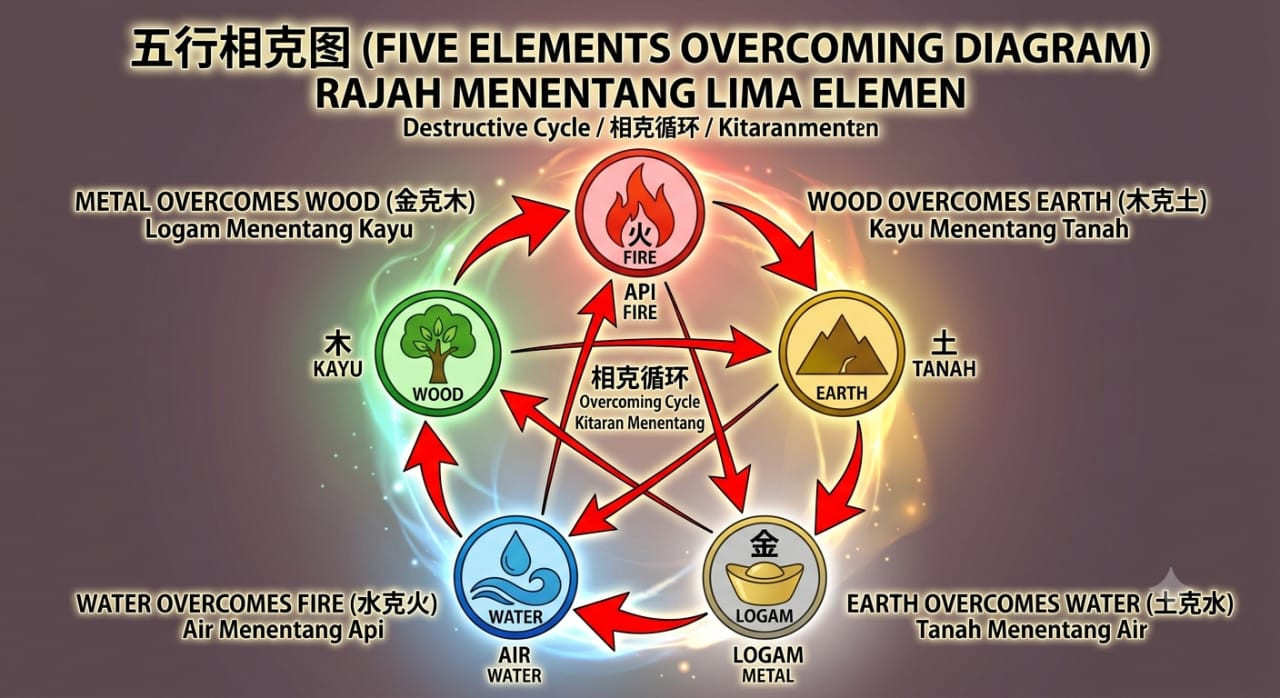
Mutual Restraint/Control (Ke Cycle)
Mutual Restraint refers to a regulating and balancing relationship:
Wood → Earth → Water → Fire → Metal → Wood
Rather than being destructive, this relationship helps maintain balance and prevents any one element from becoming excessive.
What Is the Relationship Between the Five Elements and the Human Body?
In TCM, each element corresponds to one of the five major internal organs:
| Element | Organ |
| Wood | Liver |
| Fire | Heart |
| Earth | Spleen |
| Metal | Lung |
| Water | Kidney |
Through the generating and restraining relationships of the Five Elements, TCM explains how different organs influence one another. For example, the Liver belongs to Wood while the Spleen belongs to Earth. When Liver function becomes imbalanced, it may affect the digestive functions of the Spleen and Stomach, a phenomenon known in TCM as “Wood Overacting on Earth.”
Applications of the Five Elements Theory in TCM
The Five Elements Theory helps TCM practitioners understand both normal physiological functions and the development of disease.
In clinical practice, TCM practitioners analyze symptoms, tongue appearance, pulse patterns, and the relationships among the organs to determine the underlying causes of illness and formulate appropriate treatment strategies to restore balance.
The theory also reflects the TCM concept of harmony between humans and nature, emphasizing the close relationship between health, seasonal changes, climate, and lifestyle.
Conclusion
The Five Elements Theory is an essential part of the TCM theoretical framework. Through the interactions of Wood, Fire, Earth, Metal, and Water, it helps us understand the connections among internal organs and the relationship between the human body and the natural environment.
Although it originated in ancient times, its emphasis on holistic thinking, dynamic balance, and preventive healthcare continues to influence modern TCM practice and wellness concepts today.
……………………………………………………………………………………………………………………………………………………………………………………………………..
Disclaimer: This article is for general informational purposes only and does not constitute medical advice, diagnosis, or treatment. Please consult a qualified healthcare professional before making any healthcare decisions.