
Understanding Kidney Essence, Kidney Yin, Kidney Yang, and Kidney Qi Through the Rotating Lantern
Understanding Kidney Essence, Kidney Yin, Kidney Yang, and Kidney Qi Through the Rotating Lantern
Understanding TCM Through Traditional Wisdom
Traditional Chinese Medicine (TCM) contains a wealth of philosophical concepts and medical wisdom passed down from ancient China. Much of this knowledge was developed through careful observation of nature and the application of natural principles to understand human life and health.
For many modern readers, concepts such as Kidney Essence (Jing), Kidney Yin, Kidney Yang, and Kidney Qi may seem abstract and difficult to grasp. This is not because the theories are inherently obscure, but because the lifestyles, cultural backgrounds, and ways of thinking of ancient people were very different from those of today.
To make these concepts easier to understand, let us use a traditional Chinese craft familiar to many people—the Rotating Lantern (Zou Ma Deng)—as an analogy to illustrate the relationship between Kidney Essence, Kidney Yin, Kidney Yang, and Kidney Qi.
What Is a Rotating Lantern?
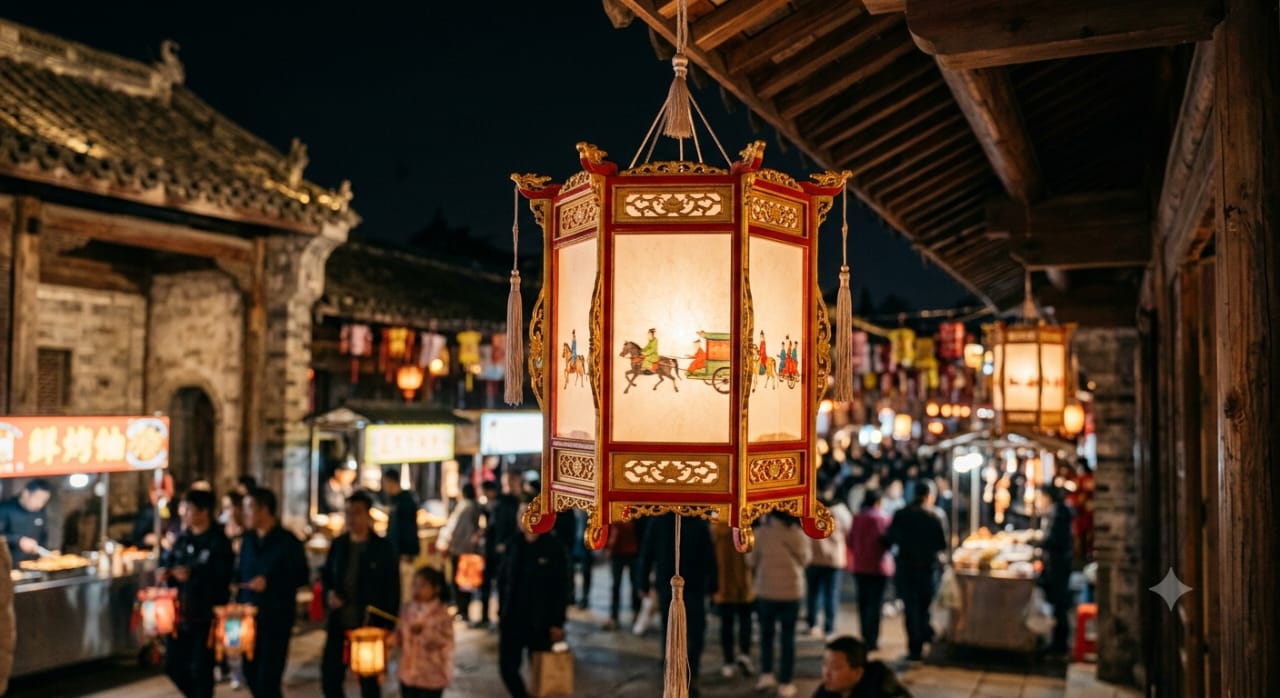
The Rotating Lantern is a traditional Chinese handicraft and festive decoration commonly seen during celebrations such as the Lantern Festival and Mid-Autumn Festival.
It is typically designed in the form of a decorative lantern with rotating paper figures inside. When the candle or oil lamp at the bottom is lit, the heat warms the surrounding air, creating an upward airflow. This rising warm air passes through an angled rotor at the top, causing it to spin. The spinning rotor then turns the paper figures, creating moving shadow images on the lantern’s surface.
From a TCM perspective, this process provides a useful analogy for understanding several important aspects of the Kidney system.
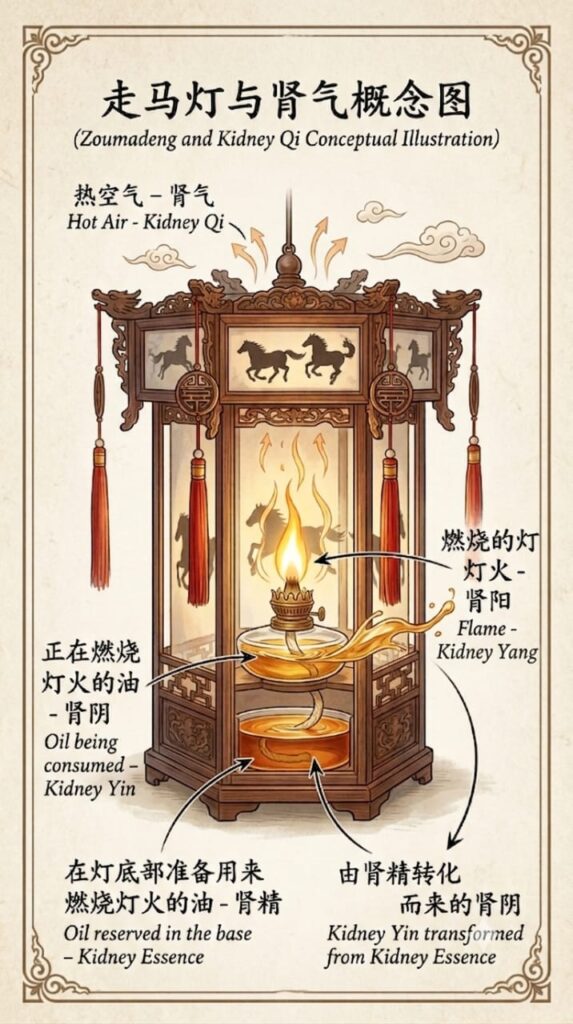
The Flame — Kidney Yang
In a rotating lantern, the flame is the source of power that drives the entire mechanism.
Without the flame, there would be no heat. Without heat, there would be no rising airflow. Without airflow, the rotor would not turn.
This can be compared to Kidney Yang in TCM.
Kidney Yang is responsible for:
– Warming the body
– Driving physiological activities
– Promoting fluid transformation and metabolism
– Activating the functions of the internal organs
Just as the flame powers the lantern, Kidney Yang provides the warmth and motive force necessary for life.
A classical TCM saying states:
“Yang Qi is like the sun in the sky.”
When Kidney Yang is deficient, symptoms such as cold intolerance, cold limbs, fatigue, and reduced bodily functions may occur.
The Rising Warm Air — Kidney Qi
As the flame burns, it generates warm air.
This rising airflow turns the rotor and enables the lantern to function.
We may compare this driving force to Kidney Qi.
Kidney Qi is the functional manifestation of Kidney Essence, Kidney Yin, and Kidney Yang. Its functions include:
– Supporting growth and development
– Promoting reproductive function
– Securing vital substances within the body
– Regulating organ functions
If Kidney Yang is the flame, then Kidney Qi can be viewed as the dynamic force produced by that flame.
Without sufficient Kidney Qi, the body’s physiological activities lose their driving power.
The Burning Lamp Oil — Kidney Yin
The flame continues to burn because it is constantly supplied with fuel from the lamp oil.
The oil nourishes the flame and prevents it from burning out too quickly.
This may be compared to Kidney Yin.
Kidney Yin is responsible for:
– Nourishing the organs and tissues
– Moistening the body
– Restricting excessive Yang activity
– Maintaining Yin-Yang balance
Although Kidney Yang provides warmth and activity, it depends on Kidney Yin for nourishment.
Without sufficient Kidney Yin, Yang becomes depleted, just as a flame eventually extinguishes without oil.
Therefore, TCM emphasizes:
“When Yin and Yang are in harmony, the spirit remains healthy.”
The Stored Oil at the Base — Kidney Essence (Jing)
The true foundation of the rotating lantern is not the flame itself, but the reserve of oil stored at the base.
Without this stored fuel, the flame cannot continue burning.
This can be compared to Kidney Essence (Jing).
Kidney Essence is one of the body’s most fundamental substances and originates from:
– Congenital Essence inherited from one’s parents
– Acquired Essence derived from food and drink
Kidney Essence is closely associated with:
– Growth and development
– Reproduction
– Bone development
– Brain function
– Vitality and longevity
Kidney Yin may be viewed as one of the manifestations and functional forms derived from Kidney Essence.
Therefore, we may understand that:
Kidney Essence is the foundation, Kidney Yin provides nourishment, Kidney Yang provides power, and Kidney Qi represents functional activity.
Understanding the Relationship Through the Rotating Lantern
Using the rotating lantern as an analogy:
Rotating Lantern| TCM Concept
Stored oil| Kidney Essence
Burning oil| Kidney Yin
Flame| Kidney Yang
Rising warm air| Kidney Qi
These four aspects are closely interconnected and mutually dependent.
– Kidney Essence forms the material foundation.
– Kidney Yin nourishes the body.
– Kidney Yang provides warmth and motivation.
– Kidney Qi drives physiological activities.
An imbalance in any one of these aspects may affect overall health.
Conclusion
Although TCM theories were developed thousands of years ago, their holistic perspective and systems-based thinking continue to offer valuable insights today.
Through the example of the rotating lantern, we can gain a more intuitive understanding of the relationship between Kidney Essence, Kidney Yin, Kidney Yang, and Kidney Qi.
Of course, this analogy is intended only as a learning tool and cannot fully represent the complexity of human physiology. Nevertheless, it allows us to appreciate the wisdom of ancient physicians in observing nature and understanding life.
………………………………………………………………………………………………………………………………………………………………………………………………………….
Disclaimer: This article is for general informational purposes only and does not constitute medical advice, diagnosis, or treatment. Please consult a qualified healthcare professional before making any healthcare decisions.