
How Did the Five Elements Theory Originate? From Observing Nature to Understanding the Human Body
How Did the Five Elements Theory Originate? From Observing Nature to Understanding the Human Body
Many people encounter the Five Elements Theory when studying Traditional Chinese Medicine (TCM). However, a common misconception is that the Five Elements simply refer to five categories: Wood, Fire, Earth, Metal, and Water. In reality, the core of the Five Elements Theory is not about five physical substances, but rather five patterns of movement and change observed in nature by ancient scholars.
So, how did the ancients develop the Five Elements Theory?
How Did Ancient People Understand the World?
The foundations of TCM originated from careful observation of nature.
Ancient Chinese scholars believed in:
“Observing the Sky above, studying the earth below, and understanding human affairs in between.”
“Observing the sky” referred to studying the movements of the sun, moon, and stars. “Studying the earth” referred to observing seasonal changes, the cycle of day and night, and the growth and decline of all living things. By understanding these natural patterns, they sought to understand human life and health.
The ancients believed that human beings live between Heaven and Earth, and that the body’s physiological activities are closely connected to the laws of nature. Therefore, to understand the human body, one must first understand nature.
Why Is Spring Associated with Wood?
Let us take spring as an example.
When the handle of the Big Dipper points toward the east, ancient observers recognized the arrival of spring.
During this season:
- Snow and ice begin to melt.
- Seeds start to germinate.
- Plants grow upward.
- Roots extend deeper into the soil.
- Hibernating animals awaken.
- Nature becomes full of vitality and life.
From these observations, the ancients concluded that the most important characteristic of spring is:
Growth, expansion, and outward movement.
In TCM, this characteristic is summarized by the concept of “generation” or “growth.”
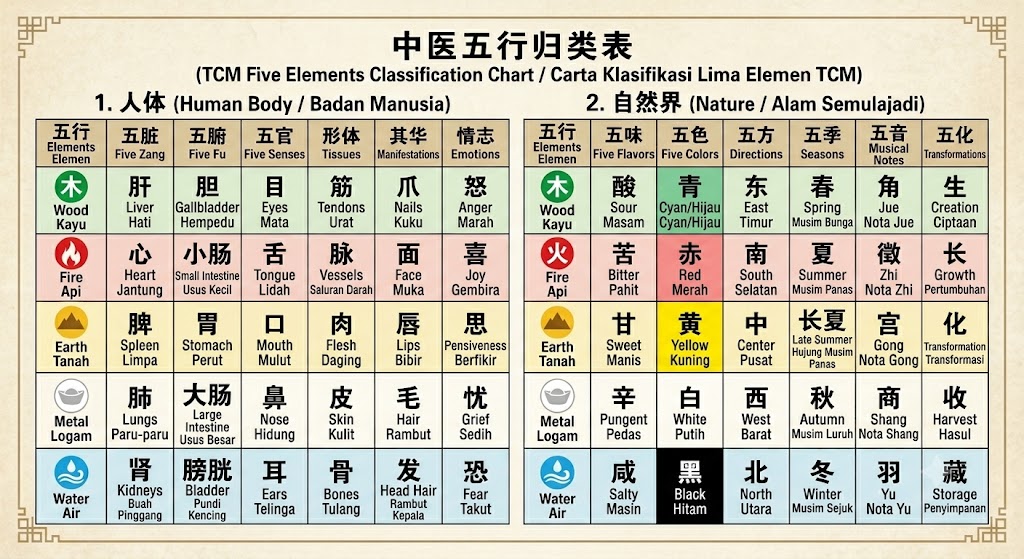
Spring is also commonly associated with gentle winds, which is why “Wind” corresponds to spring among the Five Climatic Factors.
Why Was “Wood” Chosen to Represent This Movement?
The ancients further observed that trees best embody the characteristics of spring.
Roots grow downward to absorb water and nutrients.
Branches and leaves grow upward to receive sunlight and rain.
The entire growth process of a tree demonstrates an expanding, upward, and outward movement.
For this reason, the ancients used “Wood” to represent this particular pattern of movement.
It is important to understand that:
The “Wood” in the Five Elements does not refer to actual wood or trees.
Instead, it represents an abstract quality of growth, expansion, and upward movement.
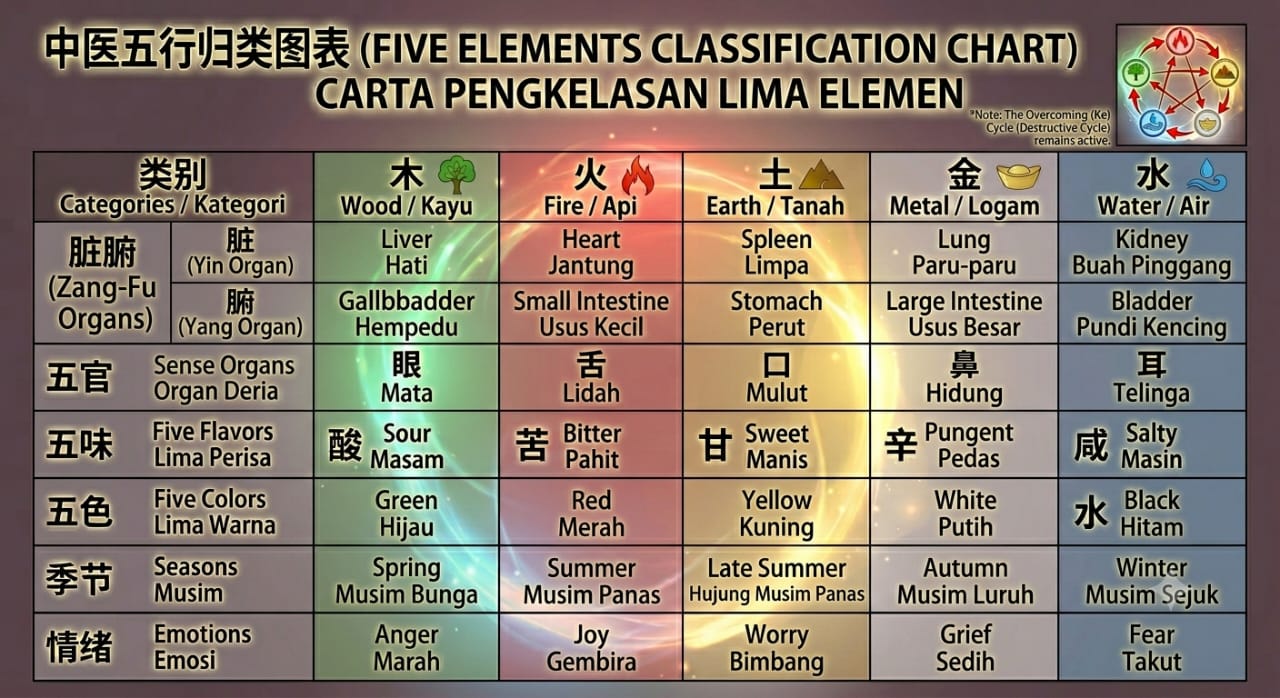
Similarly, Fire, Earth, Metal, and Water do not represent physical substances. Rather, they symbolize different patterns of Qi movement and transformation.
Why Is the Liver Associated with Wood?
Once we understand the meaning of Wood, it becomes easier to understand why the Liver is classified as Wood in TCM.
According to TCM theory, the Liver has the functions of storing blood and ensuring the smooth flow of Qi and Blood throughout the body.
When a person exercises, works, or engages in mental activities, the body requires increased blood circulation. The Liver releases stored blood into circulation to meet these demands.
When the body rests or sleeps, the demand for circulating blood decreases, and part of the blood returns to the Liver for storage.
This process of distributing and regulating blood throughout the body reflects the characteristics of expansion, growth, and free flow.
These qualities closely resemble the movement pattern represented by Wood.
Therefore, the Liver is classified under the Wood element.
The Five Elements Are Not Substances, but Patterns
One of the most common misunderstandings today is to view the Five Elements as five physical materials.
In reality, the Five Elements Theory is better understood as a system of classification and a way of thinking.
By observing different patterns and movements in nature, ancient scholars identified five fundamental modes of change—Wood, Fire, Earth, Metal, and Water. These concepts were then applied to explain organ functions, physiological activities, and disease processes in the human body.
Thus, the Five Elements Theory is not merely a philosophical concept; it is also an important framework for understanding the relationship between humans and nature.
Conclusion
The Five Elements Theory was not created through imagination alone. It emerged from centuries of careful observation of natural phenomena.
From the vibrant growth of spring being classified as Wood, to the Liver’s functions of storing and distributing blood being associated with Wood, the theory reflects the TCM principle of understanding the body through analogies found in nature.
To truly understand the Five Elements, we should look beyond the literal meanings of Wood, Fire, Earth, Metal, and Water, and appreciate the patterns of movement and transformation they represent. Only then can we fully understand how TCM uses observations of nature to explain human health and disease.
………………………………………………………………………………………………………………………………………………………………………………………………………
Disclaimer: This article is for general informational purposes only and does not constitute medical advice, diagnosis, or treatment. Please consult a qualified healthcare professional before making any healthcare decisions.